3

Investing in early stage companies; mental challenges for a public market investor

I have been involved with stock markets for more than 10 years. Over the years, I learned that a lot of commonly held beliefs can be misleading. For example, one of the first things finance students learn is ‘not to put all eggs in one basket’. Yet, the best asset managers of the world generally prefer to do concentrated investing. The logic in this case is that risk does not have to be minimized by pure diversification (which will tend to reduce return also), but rather by studying the business very well and buying with a margin of safety. Also, why would someone buy the 40th best investment idea when he could concentrate in the top 15 to 20 stocks.

The above is just one example of the type of lessons I learned which served me well in terms of public market investing. The problems appeared when I decided that its time I become an angel investor also. I quickly realized that some of these need to be ‘unlearned’ if I wanted to succeed. Below I am going to list down a few of these.

  • Diversification is not just recommended but absolutely mandatory: In early stage investing, there is no way to know in advance which company will succeed and which company will fail. No amount of research can predict where revenues will be 3 years from now. As a result, concentrated investing in early stage companies is a recipe for disaster. Most veteran angel investors recommend that one should build a portfolio of 30 to 40 companies.
  • Valuation is not the most important factor: My biggest challenge even today remains getting comfortable with valuation. In public market investing, return performance depends on the ability to buy a stock below its ‘fair value’. Thus valuation is pretty much everything for a value investor. For startups, what matters is betting on the right companies. If you have invested in a company growing revenues 15% per week, it does not matter whether you invested at a valuation of BDT20mn or BDT30mn.
  • Qualitative factors over quantitative: While qualitative factors such as corporate governance plays an important role in public market investing its much more pronounced for startups. For early stage companies, there is often no track record do be able to do any numerical analysis. We really have to judge how good an entrepreneur will be at execution based on his or her personality or communication ability.
  • Friendly activism can help improve success rates: As a public market investor, we seldom try to influence the management. Although there are examples of activism in developed world, its still pretty rare in this part of the world. For startups however, the ability to connect the founder with clients, quality talent, suppliers, media etc can all have profound impact on its chances of survival. In fact, the founders will probably select investors on their ability to make these introductions.

These are some of the most obvious differences I have found between stock market investing and startup investing. There are probably more which only time will teach me as I continue on this journey.

2

The start of EDGE Bangladesh mutual fund and our research services

In my last post written yesterday, I discussed about the decision to quit my job to start two companies. Now I will discuss the two businesses that we have started, EDGE AMC Limited and EDGE Research & Consulting Limited. We decided on the name EDGE as it is a synonym for competitive advantage and we certainly believe that we had a few such advantages. But it also suggests being at the forefront of something (pushing boundaries and trying new things). More importantly, it was the only name all of us could agree upon.

ENTRE

Source: www.pexels.com

EDGE AMC LIMITED

We always planned of starting an Asset Management Company. Our long experience in capital markets and academic knowledge made us suited for such a business. The size of the Asset Management industry in Bangladesh is also extremely small which we believed had to increase at some point.

Continue Reading

4

Risk, entrepreneurship and a post after a year


The last post I made on this blog was on February 2018 which is almost a year ago. The longest stretch of time without a single post on this blog. I wish I could say that I was too busy to write, but honestly speaking that is a pretty weak excuse. Therefore, the official answer is that I took a break.

Source: pexels.com

2018 was a very important year for me and brought major changes. The seeds of this change were actually planted in mid 2017 when I had decided to quit my job and pursue entrepreneurship. From January 2018, my relationship with my former employer was fullyover and I could concentrate on own business. When I look back there wasn’t a single reason to quit my job but rather a combination of many factors.

Firstly, I was perhaps a bit bored and felt that I wasn’t learning as much as before. Although my businesses (I will talk about them in later posts) are very related to investing, as a business owner you get to put on many hats as a salesperson (selling your product to clients), human resource manager (hiring and motivating staff), IT guy (dealing with software and hardware). To keep your business alive you are forced to learn these new things and develop yourself.

The second thing was the optionality of a big payoff. Starting a new business is risky. There is also a big opportunity cost in terms of the lost monthly salaries. Yet, if the business clicks the financial payoff could be extremely large. This kind of risk can be taken only when a person has enough savings to fall back on if the venture fails. Fortunately, by saving since my college days and living frugally I had that comfort. Worse case, I could always come back to job life.

The third and perhaps the biggest reason for starting the business was my co-founders. Most of my career I had worked alone in Bangladesh, working for companies based in New York or London. I missed working in a team environment. I am lucky to have two exceptional people as my partners. In my 10 years of career, I have the highest degree of job satisfaction at the moment.

I will end the post here. In later posts I would describe the two businesses we have started, what some of the big learning has been in the last one year and finally how my reading list has evolved ever since I have started the two companies.

2

Interest rate, stock markets and other issues in Bangladesh

Tracking interest rates in Bangladesh is no easy task!

Banking sector developments have dominated newspaper reports for the last few years. Although non-performing loan formation took the spotlight for a long period, lately soaring rates on fixed deposits and tight liquidity conditions also came under attention. Much has been written on why the interest rate cycle has turned so sharply and so I move to a slightly different territory.

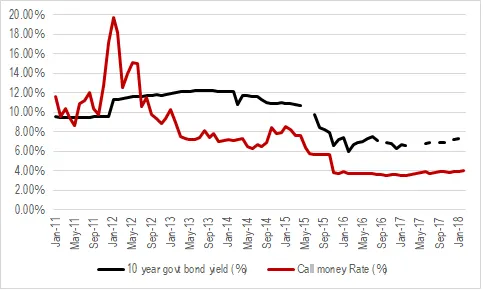
My interest however in on the public data available on interest rates. Generally we can follow a number of the indicators from the central bank website. One is the call money rate, the rate at which one bank lends to another. A quick glance at the rates will show that despite all the hue and cry about liquidity crisis the call money rate has barely bulged. This has happened because there seems to be a verbal guidance from the central bank on what the call money rate should be. This obviously makes the call money market less liquid and prevents it from being an indicator we can use to gauge interest rate conditions.

The second option is to look at yields on government bonds. There also we have a problem as the government has ceased to borrow from the bond market for more than 2 years and instead has been exclusively relying on National Savings Certificates. This lack of demand from the government depresses bond yields and prevents it from showing true liquidity scenario. The 10 year government bond yield is of particular interest to equity analysts because the Capital Asset Pricing Model uses it to form Cost of Equity in valuation models. The 10 year government bond yield in the January auction was 7.39% which means it has barely moved from the lows reached. Using this rate in valuation models will inevitably lead to asset overvaluation.

In the chart below we can clearly see that the government bond yield line is not smooth. Auctions did not take place in those periods.

A third option to track interest rate is looking at weighted average deposit rates. This data comes with a bit of lag and because the rate is an average not just fixed deposits but also current and saving deposits it will not capture the size of the move in interest rates.

Regardless of these data challenges it is very clear that interest rates in reality has gone up. Banks which not too long ago offered as low as 5/6% on fixed deposit have raised that to 9/10%. A 400bps move in a matter of months is a very steep move. And the failure to notice this will lead to missed opportunities and losses. For equity analysts not revising up their cost of equity assumptions will mistakenly feel that equities maybe undervalued. Depositors might also be unaware that rates have been increasing and can lock in lower fixed deposit rates for long periods.

Interest rate and stock prices. What does the theory say?

In a discounted cash flow (DCF) framework keeping all other things constant a higher interest rate in the economy will lead to lower values. The transmission mechanism is generally via the risk free rate (aka 10 year government bond yield) which goes up with interest rates and we end up with a higher cost of equity. Discounting future cash flows with higher discount rates will lead to lower values than the past.

There is a common misconception about companies which have a lot of net cash balance in their balance sheet. We can take the example of Square Pharmaceuticals where cash and marketable securities make up 38% of assets (there is barely any debt either). From an accounting perspective, higher interest rates would result in higher interest income on their cash balances and higher earnings. However if we use the DCF framework then the impact of higher interest rates is a net negative.

Value = Net Cash + PV of future cash flows
Where
Net Cash = Cash – Debt

The net cash on balance sheet is today’s value and is not sensitive to interest rates. The Present value of future cash flows on the other hand reduces leading to a lower value. What is however true is that companies with 0 net cash balances are more sensitive to interest rate hikes and will suffer more relatively. So a company like Square with lots of cash in hand will be less sensitive than companies burdened with a lot of debt like ACI.

What needs to be remembered is that the DCF method only mentions what the ‘intrinsic value’ of a company is. It does not say that price at any given time equals intrinsic value. Understanding the distinction can help us interpret the findings from the next segment.

What if we don’t keep all other things constant?

So far in our discussion we only changed interest rates but made no reference to cash flows. Small changes in interest rates may have no effect on the real economy. But large changes can lead to reduction in consumption as aggregate demand comes down. So some businesses might feel a double whammy as future cash flows could decline and the discount rate used on those flows could go up.

We also need to be clear about what is causing interest rates to move up. An increase in long-term government bond yield could happen because of expectations of faster economic growth (this increases the real risk free rate). In this case however, we are actually revising up our estimates of future cash flow but using a higher discount rate. The net result could be either positive or negative.

Does real world data confirm the theory?

Reality is always a bit more complex and messier than theory suggests. By and large periods of higher interest rates result in lower stock prices (and the theory is proved). However, there are periods in history when higher interest rates coincides with increasing stock prices. In the chart below in the period between 2000 and 2008 higher stock market and higher interest rates happened at the same time for the US market.
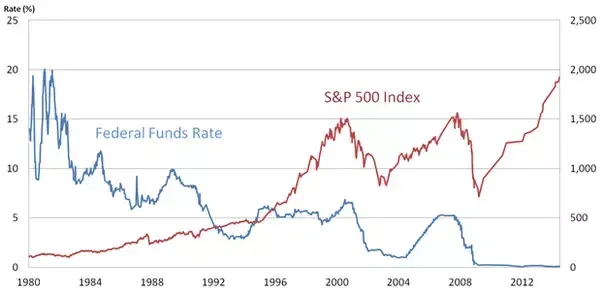
We can try to interpret this data with the benefit of hindsight. The period before 2000 coincided with the Dot Com bubble which led to an overvalued stock market. Even though interest rates came down the stock prices were probably still overvalued. There could have been an overreaction even which is why in the next period stocks actually rallied even though interest rates were increasing.
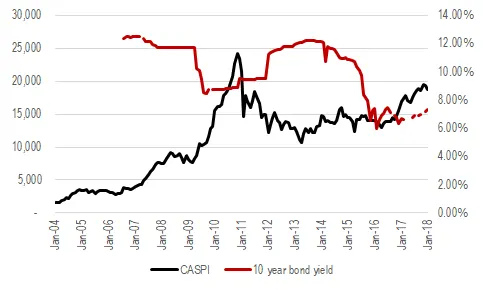
I have similarly tried to replicate using data from Bangladesh market. My choice of index was the Chittagong All Share Price Index (CASPI) which has longer history than the DGEN. With the limited history available it can be concluded that the relationship between interest rates and stocks held for most of the period. The drop in bond yields from 2007-09 coincided with one of the strongest periods for the market. While interest rates started going up from early 2010 the impact on the index only came towards the latter end (with a lag) but held on till mid 2013. Since then yields started coming down and stock market regained much of what was lost.

This proves an important point. The relationship between interest rates and stock prices hold when prices are in equilibrium (price = intrinsic value) or higher than intrinsic value during a period of rising interest rates. If stocks were undervalued to begin with then higher rates may not lead to further stock price declines. In investing world we refer to this as “how much of the risk is already priced in today”.

Final thoughts

Let us have a quick recap of what we have discussed so far.

1. Despite no clear sign from the popular data on interest rate, interest rates in the financial sector have moved up a lot.
2. According to finance theory, higher interest rates should lead to reduction in equity values. Stocks with net cash will also be negatively affected but may perform better than those with lot of debt.
3. Cause of higher rates are also important. Higher economic growth can lead to higher long-term bond yields. This may have a net positive effect as we revise our cash flow projections upwards.
4. In practice there are periods of anomalies where higher interest rates coincided with higher stock prices.

The real effect of interest rates on stocks therefore depends on prevailing stock valuations. If rate hikes are happening when stock valuations (computed using P/E or P/B) are already very high then we will inevitably see stock prices decline. If they aren’t then its harder to predict how prices will end up reacting.

Source: Data for the first chart is from Bangladesh Bank. The bond yields only show yields on new auctions. The data from the second chart sourced from a Quora question on the same topic. 

0

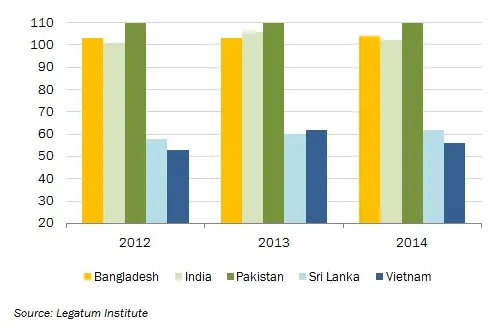
Bangladesh ranking drops one place in Legatum Prosperity Index 2014

The Legatum Institute just launched the Legatum Prosperity Index 2014. This is an annual ranking of 142 countries and is based on a number of factors including Economy, Governance, Personal Freedom, Education, Health, Entrepreneurship and Opportunity, Safety and Security and Social Capital. Across these categories, 89 variables are used to make scores and rankings

Ranking by year

Continue Reading

0

Understanding the GDP growth rate of Bangladesh

I have always had a hard time understanding why the GDP Growth rate of Bangladesh had so little volatility over the last decade or so. Not only was it growing at a decent 6% or so but the fluctuation of the growth rate has also been very low. While I strongly believe that 6% growth is not very hard to meet given our favorable demographics, low per capita income, low wages etc., I do feel that the numbers do not adequately show the business cycle fluctuations.

Let us take the case of FY 2013-14. According to our statistical agency, the GDP growth for the present fiscal year ending June 2014 would be 6.2%. This comes as a surprise as the GDP growth rate in the preceding year was 6.0%. The present fiscal year of 2013-14 in contrast faced political problems and low business confidence and consumer confidence, and if one were to make a guess we would have expected it to be below 6.0%.

So we are left with no other option but to cross check with other economic indicators. Let us go through the big three indicators.

Banking sector credit growth
Credit growth in the banking sector has been lower at around 10-11%, which is much lower than the mid-term average of around 20%. In the first quarter (Jan-March), most banks reported negative credit growth. This clearly indicates that private investment has been relatively weak.

Non-food inflation rate
Another important indicator for understanding the underlying aggregate demand in the economy is inflation (in particular non-food inflation). Here again we see we very weak in month-over-month inflation numbers. The average month-over-month inflation in the last 4 months stood at a paltry 0.13% (annualised 1.6%) resulting in a year-over-year number of only 5.23%. So, as far as inflation is concerned consumer confidence remains quite low.

Imports
Imports have, however, fared a bit better. The first 9 months saw a growth of 14% compared to the previous year. However, we must not forget that imports are growing from a low base. That is precisely why our current account surpluses continue, along with growing Foreign Exchange reserves.

Thus it seems to me that the major economic indicators show a growth rate below 6.2%. For proper economic policy-making, the decision makers surely need access to correct data which show the business cycle movements. I for one would surely be interested in looking at how the growth had been calculated.

Originally posted in The Daily Star

6

Misapplication of Economic Value Added in Bangladesh

Form a company with equity of BDT 100 mn. Put that amount in a bank deposit account that yields 10% per year. This company will continue to see a 10% growth in earnings along with a 10% return on investment (pre-tax). Is this a very good company from a shareholder perspective?

The concept of Economic Value Added (EVA) was introduced to answer this question (along with certain other things like accounting inconsistencies between companies but that is outside the scope of this article). The logic of EVA is simple. When we invest in a company with equity and/or debt there is a minimum required return we should get. This is known as the Weighted Average Cost of Capital (WACC). For the company to make economic sense the return on investment has to be at least equal to or preferably greater than the WACC. Otherwise the company is destroying value. It would be better to not have that company at all.

Let me give an example. Assume a company in Bangladesh is only financed by equity. This company would have a WACC of at least *15-16% (WACC=Cost of equity in this case). If this company does not generate a Return on Invested Capital (ROIC) then it is surely destroying shareholder’s value.

Now that the theory part is over let me go into the real problem in the case of Bangladesh. Most companies have a segment showing the Economic Value Added. The problem starts with their version of WACC. Most of them are using the government bond yield as the WACC. This is funny and infuriating because its like saying that this is a risk-free business. By the result of using very low cost of capital these companies are showing that they are generating economic profit when in reality they are not. In fact, I have a big doubt whether even 50 of the 250+ companies listed on the Dhaka Stock Exchange are generating ROIC>WACC in the truest sense.

Secondly, the calculation of invested capital is also a tricky subject. I have a lot of reservations on whether companies are calculating Invested Capital properly. By showing lower invested capital it is possible to jack up ROIC (ROIC=NOPAT/Invested Capital).

It is very important that shareholders understand whether a company is creating or destroying value. Also from the company management perspective as well EVA is a very important metric. Unfortunately it seems that neither the sponsors, the management or the minority shareholders understand the correct application of EVA.

*The 15-16% comes from Risk Free Rate plus a Risk Premium.


2

Starting a career in the financial sector

Starting a career in the financial sector from Asif Khan

This was a presentation I gave at the BRAC University-ProthomAlo Jobs Career Fair 2014 at Westin. As promised I am uploading the presentation here. For those who did not attend the seminar I am writing a mini summary.

The main players in the financial sector of Bangladesh in my opinion are Banks, NBFIs, Stock Brokers, Merchant Banks, Asset Management Companies, Insurance Companies and Credit Rating Companies. The functions of each are given below.

Slides 1-5

The Lenders

Banks and Non-Banking Financial Institutions: These mainly involve in collecting funds through deposits and sometimes other sources and lends them out to clients.

The Capital Market Players

Stock Brokers: Executes trades on behalf of clients.

Merchant Banks: Aka Investment Banks they primarily raise funds for companies that need funding. Also, in Bangladesh they manage discretionary and non-discretionary portfolios.

Asset Management: The name is self-explanatory as these companies are professional fund managers. In Bangladesh they mainly manage close-end mutual funds focusing on listed equities.

Others

Insurance Companies: In basic terms Insurance companies sell guarantees that protects their customers and use a variety of techniques to distribute and reduce that risk (e.g. Reinsurance).

Credit Rating Agencies: Main task is to check the credit worthiness of their clients and rate them.

Slide 6

All of these companies will have client facing roles, analytical roles and some other support functions. I gave some examples in the slide. Usually, Banks and NBFI’s look for people with a broader knowledge base and use aptitude tests to screen clients. Others usually look for people who have more strength in finance. However, tests and interviews will clearly vary depending on the job role.

Slides 7-8

These slides are self-explanatory. I just want to add a few points for the emphasis.

a. The days of graduating and getting a job just like that are over. To really excel in our career we have to go the extra mile. There are no shortcuts.
b. Differentiating yourself is the key. The more you can differentiate (positively) with more skills, experiences and the right networking the better it is.
c. There is no substitute for hard work.

1

Bangladesh: The real heroes (Part 2)

Bangladesh

Act of kindness

We often wonder why this country of ours called ‘Bangladesh’ continues to thrive despite the corruption, red tape, natural calamities, pollution and what not. I had much earlier mentioned that the key answer is the sacrifice of our RMG workers, remittance earners and our farmers.

But I cannot take away the credit from the common people of the country. The picture on the left was taken today when I went for a morning walk by the Dhanmondi Lake. This tea vendor suddenly stopped beside an old beggar and asked about her health. He then stopped to serve her tea.

I had crossed them by the time but went back and asked them whether I have the permission to take a picture. He was quite surprised and asked me “amader chobi tule ki korben (What benefit do you have in taking our picture?)”. I said I just wanted to take a picture.

The picture is of poor quality and is taken by my Chinese made Walton H2 Primo. But it does a good job of showing us our real heroes.